Quantum
Technologies
Technologies
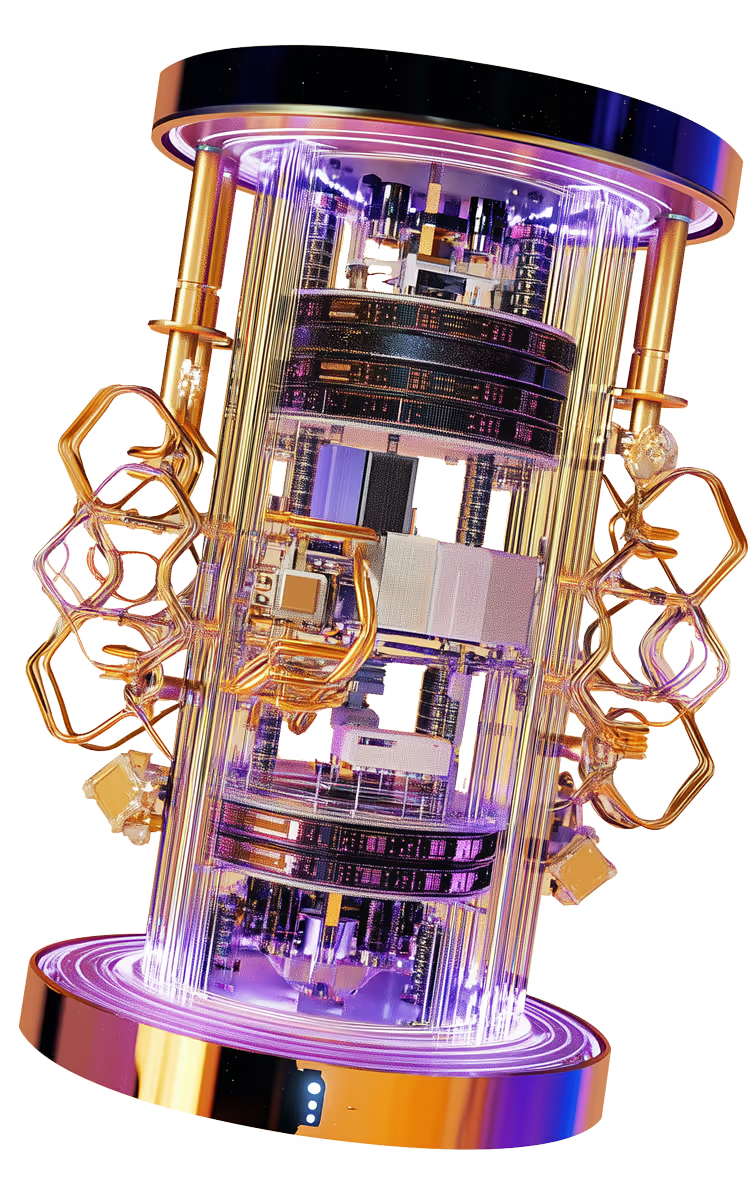







Quantum technology harnesses the principles of quantum mechanics. Quantum technology promises to revolutionise fields like materials science, medicine, and AI by enabling new simulations, order of magnitudes faster data processing, and enhanced security through quantum networking and quantum sensing.
Unlike the first quantum revolution, which produced technologies based on our understanding of quantum mechanics, such as the laser, we are now experiencing the second quantum revolution. This new phase leverages our increasing ability to manipulate particles at the quantum level, enabling computational, communication, and sensing capabilities that are impossible with purely classical (non-quantum) methods.
Over the past few years, the field has grown rapidly attracting interest well beyond research laboratories and sparking widespread efforts to explore its potential. This momentum, coupled with an urgent need for a skilled workforce, has driven the creation of new educational programs, training initiatives, and development tools across sectors.
Despite this progress, most quantum technologies are still in an early stage. They require specialised components, complex infrastructures, and an expert workforce. Sustained support for research, education and application developments is essential to unlock their full potential.
Quantum technologies can be grouped in three main areas: quantum computing, quantum communication and quantum sensing.
Quantum computing encompasses both hardware and software development. Current systems, known as Noise Intermediate Scale Quantum devices (NISQ), are limited by errors and noise. These systems need to evolve into Fault-Tolerant Quantum Computing (FTQC) to achieve full advantage, with applications in quantum simulation, optimisation, and machine learning.
Quantum communication refers to the capability of transmitting quantum information, offering unprecedented security and efficiency to our internet infrastructure. It will enhance classical internet with capabilities that are either provably unattainable or vastly less efficient when relying solely on classical technology. Furthermore, the development of a quantum internet will be key to connecting quantum computers into powerful distributed systems.
Quantum sensing uses quantum effects for exceptionally precise measurements, with applications in e.g. navigation, healthcare, and environmental monitoring. Finally, a critical consideration in developing quantum technologies is their dual-use nature: they can serve both civilian and military purposes. As such, their progress is influenced by export controls and geopolitical dynamics, which in recent years have significantly shaped the pace of innovation.